Siding in Apple Valley, MN.
Two very different phone calls make up most of our Apple Valley workload. One is a rambler or two-story from the 1970s through the 1990s whose original siding has finally given out. The other is a townhome or association building where the board, not the individual owner, controls what color and material go back up. We field both regularly, along with the smaller single-wall repairs that fall in between.
Below you'll find our current per-square pricing across the four materials we carry, notes on how each one holds up given Apple Valley's older housing stock, and how we structure a multi-building association project so buildings don't sit half-finished between phases.
- Typical build era
- Early 1970s – 1990s across most of the city
- Most common existing siding
- Original hardboard and thin vinyl, now past end of life
- Association property
- A large share of the housing stock — palette control is common
- Permit
- A City of Apple Valley building permit is required before we start; pulling that permit is on us
- Worst-first elevation
- On the more open plats, the south- and east-facing walls take the brunt of it
- Job size
- No job is too small — we run everything from a single-wall patch up to full multi-building phasing
What makes an Apple Valley siding job different?
Much of Apple Valley went up between the early 1970s and the 1990s, laid out along the curving streets and cul-de-sacs common to that generation of platting. Ramblers, splits, and two-stories fill in most of the detached lots, while a sizable share of the remaining housing stock consists of townhome or association buildings from roughly the same era. Age has caught up with a lot of that original exterior work.
On single-family properties, the recurring problem is hardboard and vinyl from the 1970s and '80s simply wearing out — hardboard swelling and delaminating along the bottom courses, vinyl gone so brittle from sun exposure it snaps at a light touch. Association buildings raise a different question: not whether the siding needs replacing, but whether the board has an approved, current palette on file and how many buildings fit into one season's schedule.
South and east of the older core, where lots run wider and the tree canopy thins out, wind-driven rain hits the walls with more force — and it lands hardest on south- and east-facing elevations. Those are the walls we check first for water intrusion behind the siding, and usually where we recommend starting when a project has to run in phases.
What siding actually costs in Apple Valley (2026)
Pricing runs by the square — 100 square feet of wall. After subtracting window and door openings and adding gable area back in, most Apple Valley splits and two-stories come out to 16-26 squares; townhome buildings scoped as a single phase go bigger. Each number reflects a complete installed job — hauling away the old material is part of the price, not extra.
These are Midwest Building Exteriors' own current 2026 installed prices, confirmed directly by owner Christian Musta: vinyl $900–$950 per square; LP SmartSide and fiber cement $1,200–$1,300 per square depending on finish; and steel $1,300–$1,500 per square (about $13–$15 per sq. ft.), dependent on various factors. One siding square equals 100 square feet of wall.
| Wall area | Vinyl ($900–$950/sq) | LP SmartSide ($1,200–$1,300/sq) | Fiber cement ($1,200–$1,300/sq) | Steel ($1,300–$1,500/sq) |
|---|---|---|---|---|
| 12–16 squaresSmaller rambler or a townhome end unit | $10,800 – $15,200 | $14,400 – $20,800 | $14,400 – $20,800 | $15,600 – $24,000 |
| 17–21 squaresSplit-entry or two-story home with an attached garage for two cars — the most common Apple Valley wall size | $15,300 – $19,950 | $20,400 – $27,300 | $20,400 – $27,300 | $22,100 – $31,500 |
| 22–26 squaresLarger two-story, or a split-entry with a finished walkout level | $19,800 – $24,700 | $26,400 – $33,800 | $26,400 – $33,800 | $28,600 – $39,000 |
| 27–36 squaresLarger detached home, or a single association building phased as one job | $24,300 – $34,200 | $32,400 – $46,800 | $32,400 – $46,800 | $35,100 – $54,000 |
- Vinyl ($900–$950/sq)
- We use the Exterior Portfolio Market Square profile at .44 mil, or a comparably built panel from Royal Building Products or CertainTeed. Set next to the thin factory-original vinyl still clinging to many Apple Valley ramblers, this gauge holds its color longer, bends under impact instead of cracking, and is noticeably heavier in the hand.
- LP SmartSide ($1,200–$1,300/sq)
- Engineered wood is usually what we steer Apple Valley homeowners toward first. Fasteners grip it tightly, and its thicker profile tolerates the freeze-thaw stress this climate puts on exterior walls better than most alternatives. It's sold pre-finished, or bare for a field-applied coat, and which option you pick shifts the price within that band.
- Fiber cement ($1,200–$1,300/sq)
- A common choice when an association's approved palette specifies it. It's dense, holds a factory finish for years, and resists fire — though it tolerates sloppy installation less forgivingly than engineered wood does, a point we expand on further down. It's priced the same per square as LP SmartSide.
- Steel ($1,300–$1,500/sq)
- Christian's current installed steel range is $1,300–$1,500 per square, or roughly $13–$15 per square foot, with the final number dependent on various factors. It won't rot, resists woodpeckers, and stays rigid, making it worth a look when low upkeep matters more than the higher initial cost.
Line items that move a Apple Valley number
- Optional insulated siding, add on request+$150 – $300 per square
- Replacing rotted or delaminated sheathing/OSB found once old siding comes off+$85 – $160 per sheet
- Correcting kickout and step flashing at a roof-to-wall junction+$350 – $900 per location
- New drip caps and trim wrap at window and door heads+$45 – $120 per opening
- Replacing house wrap left exposed over bare sheathing+$60 – $110 per square
- Pulling and resetting soffit, fascia, and guttersquoted per elevation
- One-off elevation or partial repair workquoted per job — no minimum
Ranges are installed totals in 2026 dollars — removal and disposal of the existing siding, house wrap, flashing and kickout details, trim, fasteners, permit, and cleanup included. They are planning numbers, not a quote. Wall area, number of stories, trim and gable complexity, window count, sheathing repair, and color availability all move the final figure. Repairs and partial-wall work are quoted on their own; there is no job-size minimum.
Which siding material is right for an Apple Valley home?
We don't push one brand over another — all four material families get the same install attention from our crews. Here's an honest breakdown of vinyl, LP SmartSide, fiber cement, and steel against the housing Apple Valley actually has, including the aging original hardboard and vinyl we tear off constantly.
| Material | Life in MN | Installed / square | Install time |
|---|---|---|---|
| Vinyl (Exterior Portfolio Market Square profile, .44 mil gauge)Noticeably tougher than the thin original vinyl on so many Apple Valley homes from the 1980s and '90s. No paint required, ever, and it bends rather than shattering on impact. Royal Building Products and CertainTeed offer profiles we also stock at similar quality. | 20–40 years | $900 – $950 | 3–5 days |
| LP SmartSide engineered woodOur go-to recommendation when replacing 1970s-90s siding here. The deeper profile and stronger fastener hold handle both freeze-thaw cycling and typical on-site build variance more gracefully than a cement-based board. Available pre-finished, or unfinished for a field-applied coat. | 30–50 years | $1,200 – $1,300 | 3–5 days |
| Fiber cementDense, fire-resistant, slow to fade — we put it up whenever a homeowner requests it or an association's palette demands it. Its long-term performance hinges more than the other materials on installation precision — clearances, flashing, caulk joints — which we cover in more detail below. | 40–50+ years | $1,200 – $1,300 | 3–5 days |
| SteelMakes sense when the aesthetic and the budget both line up: it won't rot, resists woodpeckers, and holds its shape. It isn't dent-proof, though — a hard-enough hailstone still leaves a mark, and a marked panel still means filing a claim rather than skipping the process. | 40–50+ years | $1,300 – $1,500 | 4–5 days |
Why we default to LP SmartSide — and what the research actually says
This holds true across the category, not for one manufacturer's product line. Every fiber-cement lap board starts from that same porous cement matrix, whichever company manufactures it. Testing on fiber-cement boards, published in a peer-reviewed journal, found that repeated freeze-thaw cycling measurably alters the board's internal structure and how it flexes (Gorzelańczyk & Schabowicz, Materials journal, 2019, retrieved 2026-09-16). Minnesota's climate puts every exterior wall through that freeze-thaw cycle dozens of times annually, so this applies broadly here.
Moisture studies point the same direction. a multi-year study run by Building Science Corporation at its Vancouver test facility exposed fiber-cement-clad walls to sustained, controlled wetting and traced moisture performance back mainly to the drainage and drying details behind the cladding, more than to the board material itself (BSC Research Report RR-1306, retrieved 2026-09-16). Field reports documenting butt-joint gapping and caulk failures on fiber-cement lap siding echo that conclusion: whether it holds up comes down to clearance gaps, caulk joints, and flashing detail, not the board itself (InspectAPedia field reports, retrieved 2026-09-16).
None of this means fiber cement performs poorly, nor does it single out one manufacturer over another. It explains why we usually steer Apple Valley homeowners toward LP SmartSide instead — an engineered-wood system tends to absorb ordinary installation variance more comfortably in a freeze-thaw climate like this one. Where an association's palette requires fiber cement, or a homeowner simply wants it, we follow the clearance, fastening, flashing, and caulk-joint specifications the manufacturer publishes, since getting those details right is what keeps its warranty valid.
Is steel siding storm-proof?
Steel often gets marketed as storm-proof, which overstates the case. It's rigid, fire-resistant, and rot-proof, sure — but a strong-enough hailstone still leaves a dent, no different from the dent an adjuster would note on a gutter or fascia board. Choose steel because you want something durable and low-effort and you're drawn to its look, not on the promise that hail can't reach it.
Will your Apple Valley association need to sign off on siding color?
For most of Apple Valley's townhome and association properties, the answer is yes, and getting that sign-off early is what keeps a project on schedule. We handle the process directly: bringing real color and profile samples on-site, photographing the current elevations in daylight, and assembling a written submittal covering product, color, and trim in a format your board can actually vote on.
Because many of these associations were built in that same 1970s-to-1990s window as their original siding, the product named in an older governing document has often gone out of production entirely. When that happens, we identify the closest current match among the brands we stock and document it as the equivalent — instead of sending your board paperwork for a product that isn't sold anymore.
Multi-building properties get scoped and priced as one project rather than per building. Our multifamily and HOA and commercial pages go into more detail on how that phased approach works. The rough order: tackle the walls exposed to the harshest weather first, finish each building fully, then roll crews forward to the next.
- Actual samples of color and profile carried to the site and shot alongside the current walls
- A submittal package naming the product, color, and trim, laid out however your board needs it for a vote
- Research into the closest current match whenever an old palette names something no longer manufactured
- A building-by-building schedule for association property, sequenced by which walls face the worst exposure
- One point of contact for the board, the property manager, and individual owners alike
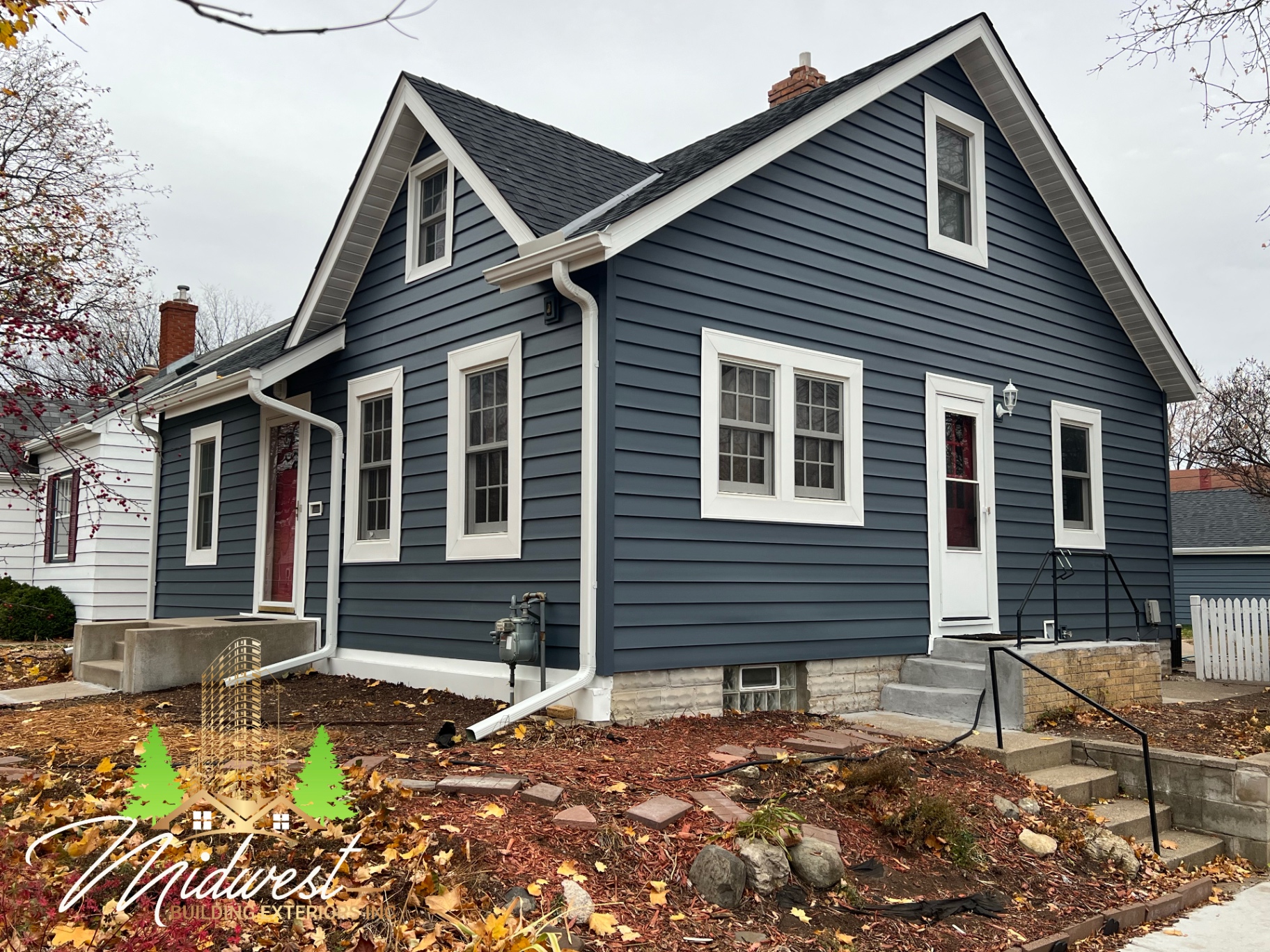
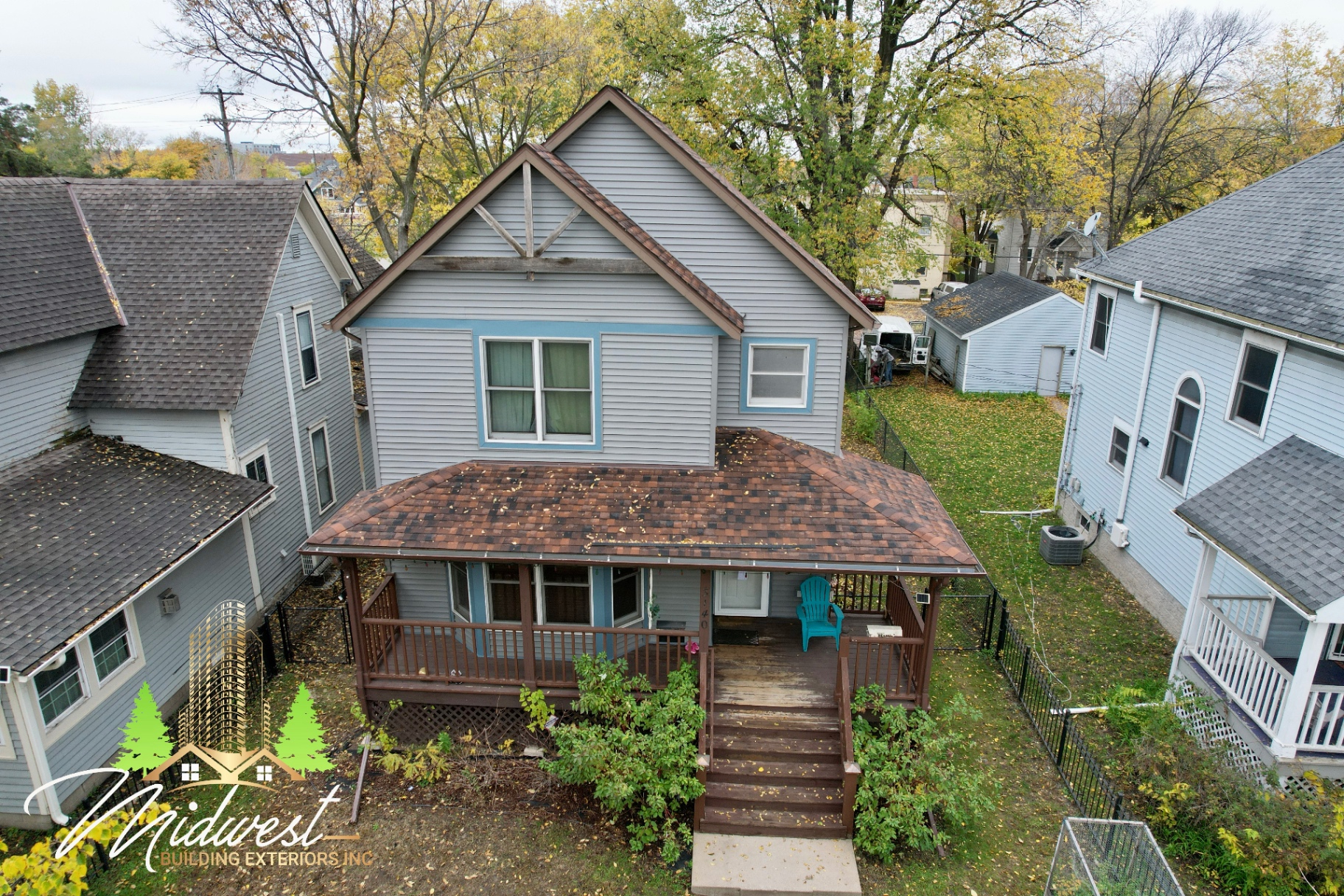
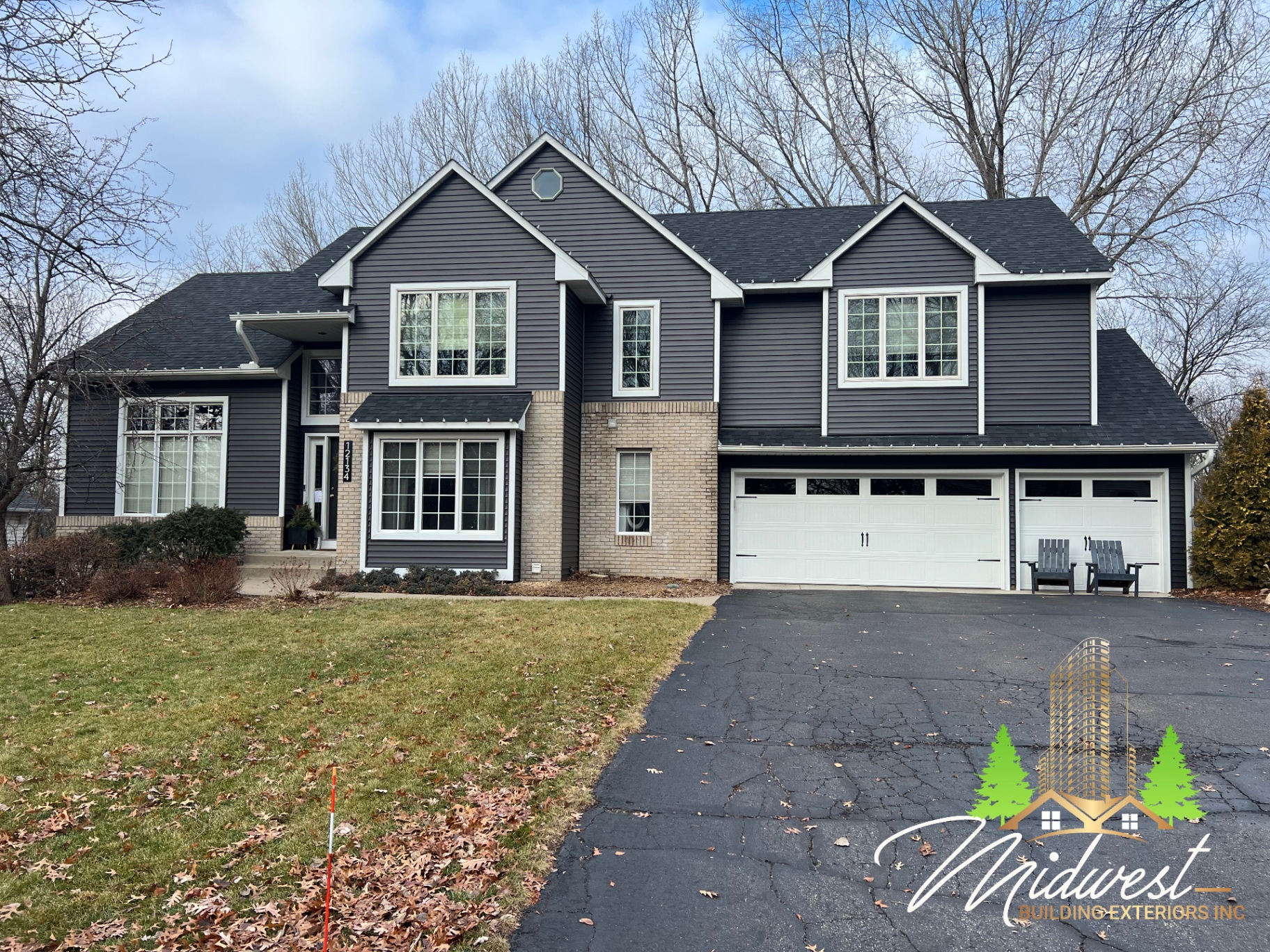
Siding work from our crews
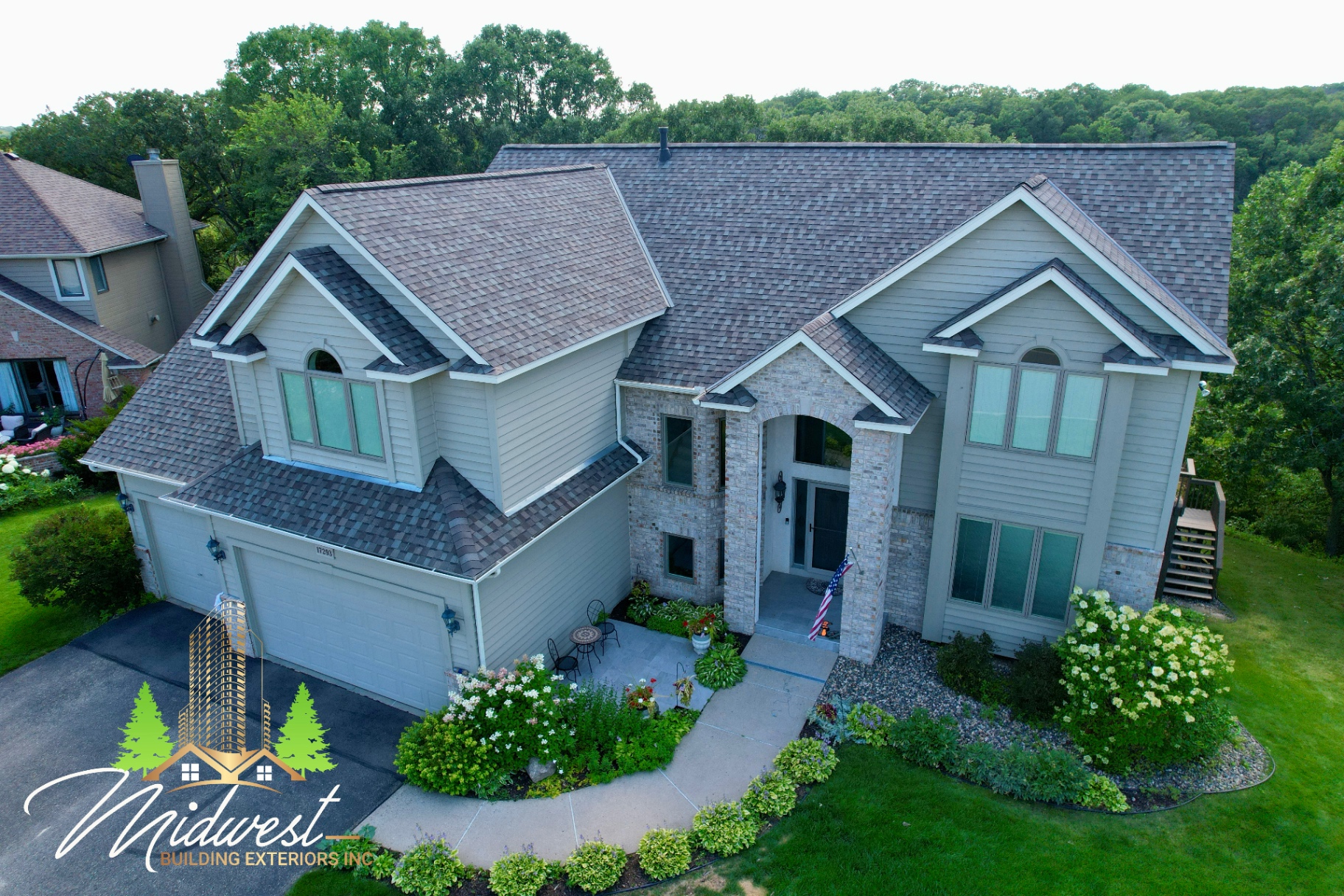
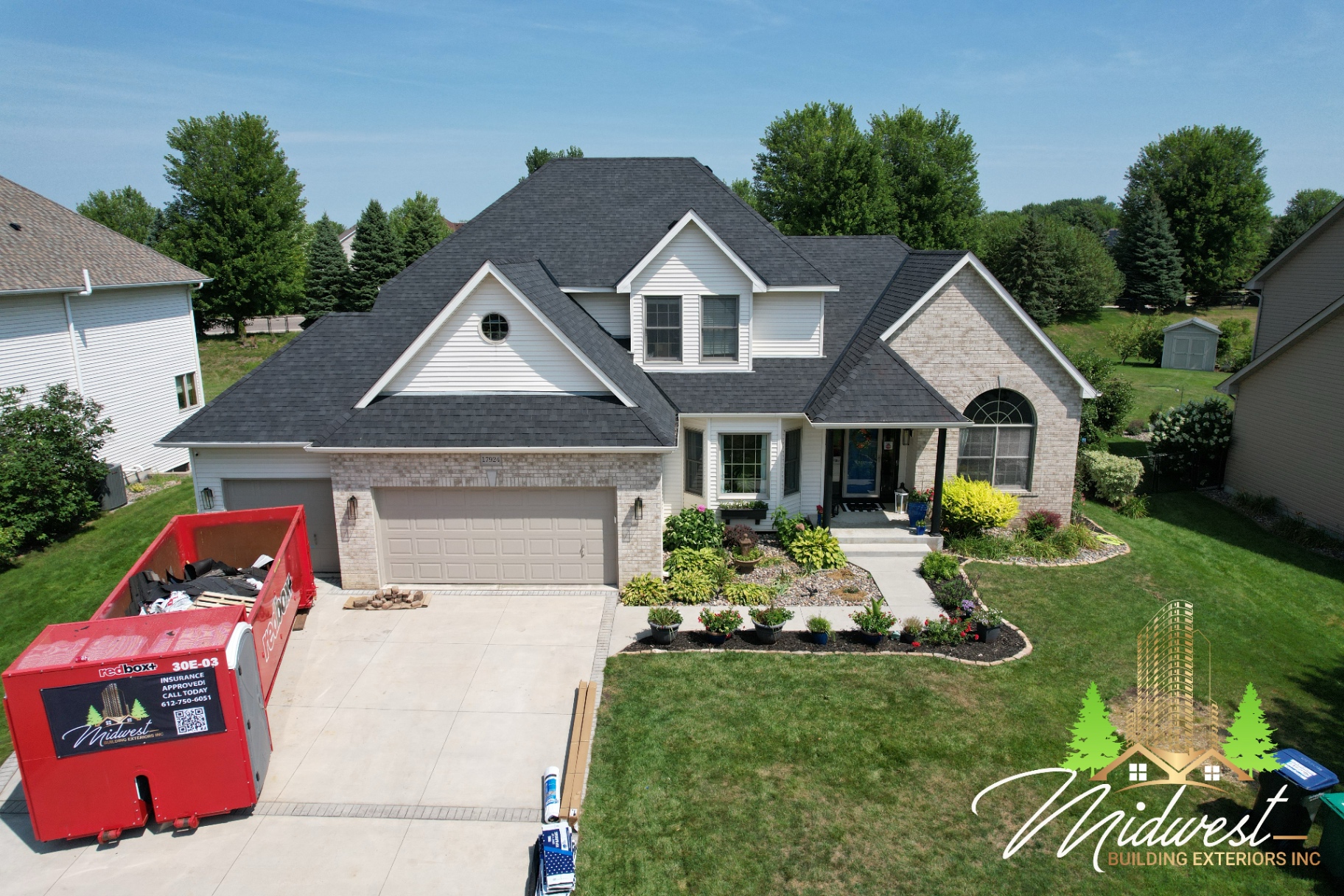
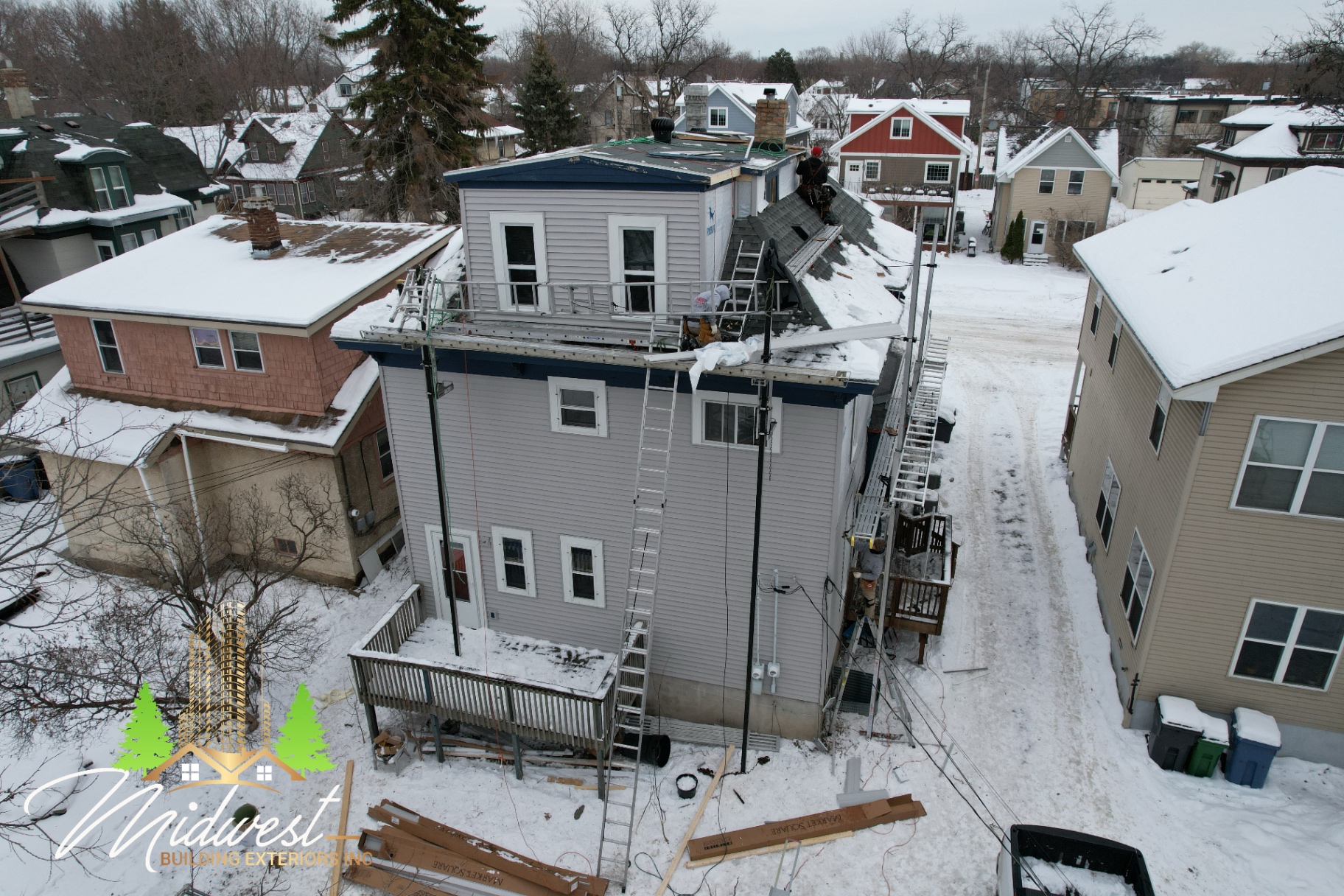
Do you do siding repairs in Apple Valley, or only full replacement?
We handle either scope, and there's no floor on job size. Whether it's a section of cracked panels down near grade, storm damage limited to a single elevation, or opening up a wall to trace a flashing leak, each gets priced on its own terms — we won't steer you toward a full re-side you weren't asking for.
Color match tends to be what actually decides repair versus replacement, particularly on Apple Valley's older housing. Decades of fading and chalking on original 1970s and '80s vinyl and hardboard mean a new panel — even in a technically matching color — will usually stand out against the rest of the wall. When we see that, we'll tell you up front and suggest re-cladding the whole elevation rather than patching it.
Any of these materials can pick up an insulated backing on either a repair or a full replacement, and we always show that cost separately instead of bundling it into the base number.
Who else does siding work in Apple Valley?
Homeowners and association boards in Apple Valley typically gather multiple siding bids, and several of those names show up via a truck parked curbside or a flyer on the door — nothing you can independently confirm. So we did the checking ahead of time, on the companies most often quoted alongside us in Apple Valley and the south metro.
We're not trying to knock anyone else in this list. Each of these companies is licensed to do residential building work in Minnesota, which is simply table stakes for a contractor on your exterior. We present what the state record shows, call out anything we couldn't pin down, and leave the judgment call to you.
| Company | MN license | Status | Expires | Licensed address | BBB |
|---|---|---|---|---|---|
| Craftsman's ChoiceCraftsmans Choice Inc | BC384780 | IssuedEnforcement flag on state record | 2027-03-31 | 5680 Quam Ave NE, Ste A, St Michael, MN 55376 | Unverified — BBB's published listing could not be retrieved on 2026-09-16. Check bbb.org directly. |
| Super SidersWinslow Companies (DBA Super Siders) | BC632296 | Issued | 2028-03-31 | 10533 Karston Ave NE, Albertville, MN 55301 | Unverified — BBB's published listing could not be retrieved on 2026-09-16. Check bbb.org directly. |
| Minnesota Exteriors IncMinnesota Exteriors Inc | BC002877 | Issued | 2028-03-31 | 8600 Jefferson Hwy, Maple Grove, MN 55369 | Unverified — BBB's published listing could not be retrieved on 2026-09-16. Check bbb.org directly. |
| Twin Cities Siding & RoofingTwin Cities Siding Professionals Operating Company LLC (DBA Twin Cities Siding and Roofing) | BC752041 | Issued | 2027-03-31 | 6500 Carlson Dr, Eden Prairie, MN 55346 | Unverified — BBB's published listing could not be retrieved on 2026-09-16. Check bbb.org directly. |
| TWS RemodelingThe Window Store Inc (DBA TWS Remodeling) | BC773859 | Issued | 2028-03-31 | 9000 Science Center Dr, New Hope, MN 55428 | Unverified — BBB's published listing could not be retrieved on 2026-09-16. Check bbb.org directly. |
| Garrett ConstructionGarrett Construction Limited Liability Company | BC785223 | Issued | 2027-03-31 | 2321 Rockwood Ave, St Paul, MN 55116 | Unverified — BBB's published listing could not be retrieved on 2026-09-16. Check bbb.org directly. |
| Anchor Roofing & ExteriorsHudson Enterprises Inc (DBA Anchor Roofing and Exteriors) | BC689351 | Issued | 2028-03-31 | 101 Bridgepoint Way, Ste 140, South St Paul, MN 55075 | Unverified — BBB's published listing could not be retrieved on 2026-09-16. Check bbb.org directly. |
- Craftsman's Choice — License BC384780 was listed as Issued through March 31, 2027, at 5680 Quam Ave NE, Ste A, St Michael, MN 55376 in the Minnesota DLI residential contractor export retrieved September 16, 2026. The export's enforcement-action field is marked, but the export provides no action type, date, outcome, case number, or order text; we therefore make no claim about what occurred. DLI's enforcement materials state, ‘A Consent Order is not a finding of fact or admission of guilt.’ The export does not establish whether this flag relates to a Consent Order. Verify the current license and any enforcement information directly at dli.mn.gov.
- Super Siders — Licensed and active with no enforcement flag on the export. Long-standing license, originally issued 2008. Their own marketing claims about years in business and families served are self-reported and we have not verified them.
- Minnesota Exteriors Inc — Licensed and active with no enforcement flag, and one of the oldest license records in the export — originally issued January 1992. A separate entity, Minnesota Exteriors Commercial LLC (BC741401), holds its own active license for commercial work.
- Twin Cities Siding & Roofing — Licensed and active with no enforcement flag. Note the operating entity name differs from the trade name — worth checking that the contract you are handed names the licensed entity.
- TWS Remodeling — Licensed and active with no enforcement flag. An earlier, similarly named license (BC283598, Window Store LLC The) shows as voluntarily terminated — the current active record is the one above.
- Garrett Construction — Licensed and active with no enforcement flag; the license number published on their own site matches the state record. The license was originally issued in August 2021, which is worth weighing against marketing that cites a longer operating history.
- Anchor Roofing & Exteriors — Licensed and active with no enforcement flag. As with several on this list, the licensed entity name differs from the trade name you see on the truck.
License numbers, status, expiry, and addresses below are taken from the Minnesota Department of Labor and Industry residential contractor license export, retrieved 2026-09-16. License status and enforcement flags change — confirm current status yourself at dli.mn.gov before you sign anything with anyone, including us. BBB accreditation and rating are shown as unverified because we could not retrieve BBB's own published listings at the time of writing; we would rather label that gap than repeat a number we have not read at the source.
Apple Valley siding questions
- How much does siding cost in Apple Valley, MN?
- Vinyl installed runs $900 to $950 per square (a square is 100 square feet of wall), and LP SmartSide or fiber cement run $1,200 to $1,300 per square depending on finish. A typical two-story or split-entry here, with room for two vehicles in the garage, works out to 17 to 21 squares, putting vinyl around $15,300 to $19,950 and LP SmartSide or fiber cement around $20,400 to $27,300 installed. For steel, Christian's current installed range is $1,300 to $1,500 per square (about $13 to $15 per square foot), dependent on various factors.
- How long does it take to reside a home in Apple Valley?
- For an average detached home, budget three to five days in vinyl, LP SmartSide, or fiber cement, and one day more than that — four to five — if you go with steel. Rain, wall size, trim work, and sheathing found rotted under the old hardboard can all stretch things out. On association jobs, it's usually the board approval, not the install itself, that takes the longest.
- My siding is original to my Apple Valley house from the 1970s or 80s — is it worth repairing or should I replace it?
- Replacement is usually the better call. By this point, hardboard from that era has typically swollen and delaminated along the bottom courses, and the original thin vinyl tends to crack under ordinary handling. We'll still inspect and tell you honestly if a section can be saved, but at this age, full replacement is generally the more cost-effective route long-term.
- Which siding material handles Minnesota's freeze-thaw cycles best?
- For most Apple Valley homes we lean toward LP SmartSide engineered wood by default. Its deeper profile grips fasteners securely and handles both the freeze-thaw swings and normal build tolerances better than a cement board tends to. Vinyl, fiber cement, and steel are all still solid choices, though, depending on your budget, an association's palette rules, or simply what look you're after.
- Does my Apple Valley townhome association require a specific siding color or material?
- Likely yes, for owners in Apple Valley's townhome or association developments. We run that approval process ourselves — on-site samples, elevation photos, and a written submittal the board can vote on. If the governing documents name a discontinued product, we research and document the closest current-production match.
- Can you phase a siding project across multiple buildings for our association?
- Yes. We scope the entire property upfront, then schedule and price building by building, typically beginning with whichever elevations face the toughest wind and moisture exposure. Each building's envelope gets finished completely before we move crews to the next, rather than leaving multiple buildings partially open at once.
- Is steel siding hail-proof?
- No. It resists rot and won't burn, but hail can still dent the metal — and dented gutters or fascia are the kind of evidence adjusters typically look for after a storm. Steel is a durable, low-maintenance option, but it doesn't exempt you from storm damage or from needing to file an insurance claim.
- Is vinyl siding still a good option for an older Apple Valley home?
- Yes, provided you upgrade to a thicker gauge than the original. Our Exterior Portfolio Market Square profile at .44 mil never needs a repaint and bends instead of cracking on impact — a real step up from the thin builder-grade vinyl still found on many Apple Valley homes from the 1980s and '90s.
- Do you handle single-elevation or partial siding repairs, or only full houses?
- Both, and there's no minimum job size. One damaged section, a single storm-hit wall, or an entire building — each gets its own quote. Color match usually decides whether a partial repair or a full-elevation re-clad makes more sense, especially against faded original siding, and we'll be upfront about which option we'd pick before you commit to anything.
- Do you offer insulated siding in Apple Valley?
- Yes, though it's an add-on rather than part of the standard price. Plan on an extra $150 to $300 per square over the base material, broken out separately so you can decide if the added R-value is worth it.
- Does a warranty cover the labor on a siding job?
- Yes — our Lifetime Craftsmanship Warranty backs the labor on any siding job we complete, the same coverage we stand behind on roofs, layered on top of whatever material warranty comes from the manufacturer of the product you pick. You'll find the exact language spelled out in your contract paperwork.
- If I have storm or insurance damage in Apple Valley, can you assist?
- Sure, though the bulk of our Apple Valley jobs are ordinary replacement or repair work, not storm-related. On a storm job, our crew photographs the damaged walls and compiles that record for your insurer's adjuster. We stick to documenting and fixing the siding itself; we're not a substitute for a public adjuster.
Christian Musta
Owner, Midwest Building Exteriors
Christian Musta owns Midwest Building Exteriors, a family-led exterior restoration company with offices in Richfield, Eagan, and St. Croix Falls. He has spent 10 years in the insurance restoration industry and holds a Minnesota Public Adjuster license — a credential that reflects his command of policy language, coverage, and claim ethics. Midwest Building Exteriors does not act as a public adjuster on jobs it repairs; Christian applies that insurance knowledge to how our crews document damage and communicate with the homeowner's own insurance adjuster during a project. Every city guide on this site is written and reviewed by him, using measurements, adjuster scopes, and tear-off findings from jobs his own crews completed.
- 10 years of experience in the insurance restoration industry
- Licensed Minnesota Public Adjuster — held as a credential of competency, ethics, and policy-language knowledge, not an adjusting service we provide
- Minnesota-licensed residential building contractor
- Manufacturer-certified roofing installer (Owens Corning, TAMKO, CertainTeed)
- Installs vinyl, LP SmartSide, fiber cement, and steel siding systems
Last reviewed
Flexible financing options available.
We make protecting and upgrading your home or commercial property more affordable with flexible financing programs through trusted lending partners. Get started with comfortable monthly payments — ask us about financing options during your free inspection.
- Quick pre-qualification — no impact on your credit score
- 0% intro APR & low-rate plans through vetted partners
- Residential & commercial projects of every size